
We frequently encounter clients at Swati Water Purification who are perplexed by the distinction between soft and hard water. Although it seems complicated, the idea is straightforward. The main cause of the discrepancy is the quantity of dissolved minerals, primarily calcium and magnesium, in the water. Small amounts of these minerals are safe to consume, but they can cause major issues with home appliances, industrial machinery, and Water Softeners Manufacturers in Gandhinagar systems.
Ions of calcium and magnesium are highly concentrated in hard water. These minerals are absorbed by groundwater when it flows through soil that is rich in minerals and limestone. The water gets “hard” as a result, and you could see white scale buildup on kitchenware, shower heads, and faucets. Hard water makes it difficult for soap to lather, and after washing, clothing may feel scratchy. Hard water can lead to scale accumulation in pipelines, boilers, cooling towers, and heat exchangers in industrial settings. This scaling shortens equipment life, increases energy consumption, and decreases efficiency.
Conversely, the amounts of calcium and magnesium in soft water are extremely low. It keeps scale from forming, preserves plumbing systems, and makes soap lather more easily. Washing machines, geysers, RO systems, and industrial equipment all operate better with soft water. Soft water usage lowers maintenance expenses and downtime in manufacturing facilities.
At Swati Water Purification, we Water Softeners Manufacturers in Gujarat specialize in offering cutting-edge water treatment technologies that effectively transform hard water into soft water. We design equipment to meet the needs of homes, businesses, and industries as manufacturers and providers of water filtration systems.
Systems for Water Softening
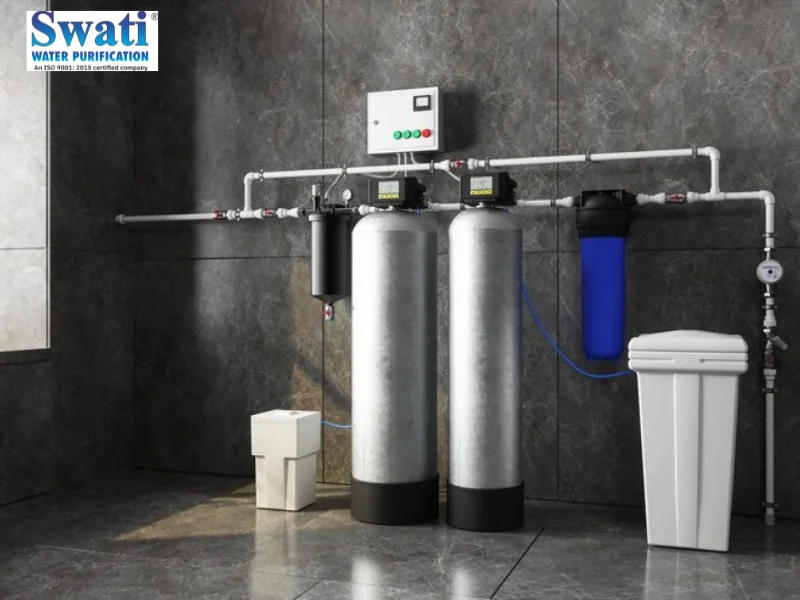
Using ion exchange technology, our water softener plants are specifically made to remove hardness from water. Through a resin bed, sodium ions are used in this process to replace calcium and magnesium ions. Soft water that doesn’t create scale is the end result.
The following are our typical water softener specifications:
500 liters per hour to 50,000 liters per hour is the range of capacity.
Options for FRP or MS pressure vessels
Superior ion exchange resin
Multiport valve that can be operated manually or automatically
A maximum operating pressure of 6 kg/cm²
Ideal for municipal water and borewells
Depending on the needs of the user, we Water Softeners Manufacturers in Ahmedabad produce both completely automatic and manual softeners. Compact variants are offered for homes and small flats. We offer huge industrial softening systems with larger flow rates for use in companies, hotels, and hospitals.