
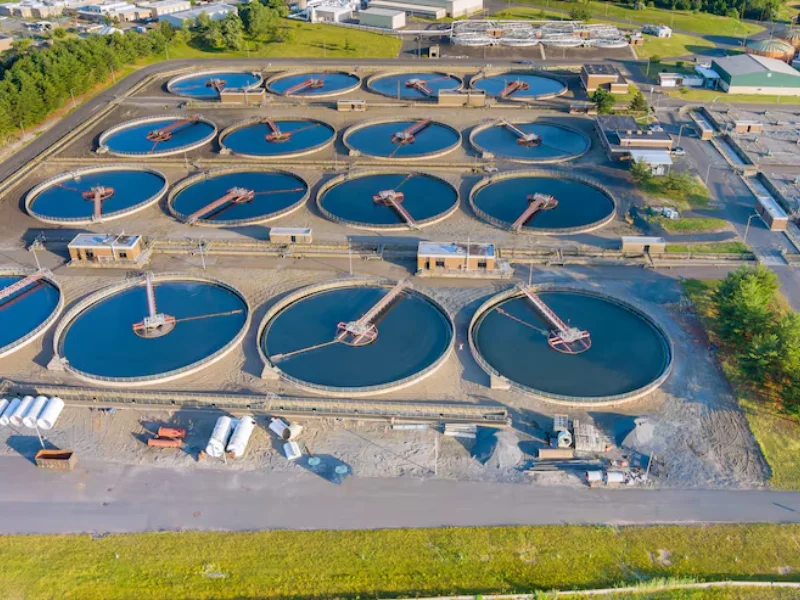
At Swati Water Purification, this is among the first questions that customers ask us. In all honesty, the amount of area needed for a STP Plant Manufacturers in Ahmedabad relies on a number of real-world variables, including site circumstances, wastewater type, treatment capacity, and technology. There isn’t a single, universal solution. Nonetheless, we always give our clients a detailed layout plan prior to installation so they are aware of the precise amount of space required.
We at Swati Water Purification develop and build sewage treatment plants for use in homes, businesses, hotels, hospitals, factories, and other establishments. The plant capacity, which is expressed in KLD (kiloliters per day), is the primary determinant of the amount of area needed. For instance, depending on the technology, a small 10 KLD STP plant would need 400–600 square feet. Approximately 1200 to 2000 square feet may be needed for a 50 KLD plant. Naturally, larger plants (100 KLD and up) will need more area, thus we plan these projects with appropriate equipment layout and civil drawings.
The many STP Plant Manufacturers in Gandhinagar technologies that Swati Water Purification offers include MBBR, SBR, and traditional activated sludge process systems. Both residential and commercial projects can benefit from MBBR-based plants, which typically demand a moderate amount of area. SBR systems might be a viable option when space is restricted because they are more compact. We also create compact or prefabricated STP systems that minimize the footprint without sacrificing treatment effectiveness in cases where land availability is an issue.
Important parts including the bar screen chamber, equalization tank, aeration tank, clarifier, filter unit, sludge drying bed or sludge storage tank, and treated water tank are usually found in our STP Plant Manufacturers in Gujarat. Wastewater flows smoothly from one step to the next because to the layout’s design. The organic load and retention time requirements determine the size of the aeration tank. The capacity and performance requirements of the plant are taken into consideration while choosing pumps, diffusers, blowers, and control panels.
Depending on the client’s request, our STP plants are constructed with long-lasting materials such prefabricated FRP and MS buildings, mild steel tanks coated with epoxy, or RCC civil structures. Level indicators, motor protection systems, and automatic operation characteristics are all included in the electrical control panel. BOD, COD, TSS, and other pollution control board discharge standards are met by our systems. Treated water can be reused for gardening, flushing, cooling towers, or other non potable purposes.
Equipment footprint is only one aspect of space planning. At our STP Plant Manufacturers in Ahmedabad organization, we also take into account pipeline routing, ventilation, maintenance access, and potential future growth. We make sure there is enough room for operators to walk about and for pumps and blowers to be serviced safely. Before completing the design, we carefully evaluate the ventilation and access options for basement installations.
Our strategy at Swati Water Purification is straightforward. We research the location, comprehend the water load, examine discharge regulations, and then provide the best and most space-efficient STP solution. Before proceeding, we give clients thorough plan drawings and walk them through each step of the procedure.